Executive Summary: The Dawn of Algorithmic Combat
By March 2026, the digital and physical worlds have collided in a way never before seen in human history. The ongoing conflict between the United States and Iran has moved past traditional “Electronic Warfare” and into the era of Algorithmic Combat.
For the first time, we are witnessing the large-scale deployment of AI Target Factories, Autonomous Interceptor Swarms, and Agentic Command Structures. This isn’t just a war of missiles and men; it is a war of Inference vs. Counter-Inference.
At Vucense, we analyze this conflict not through battle-by-battle commentary, but through the lens of Systems, Use-Cases, and Sovereignty Risks. The technology being “field-tested” today in the Middle East will define the security architecture of the next decade.
Direct Answer: How is AI being used in the US–Iran war in 2026? (ASO/GEO Optimized)
AI is being used in the US–Iran war as a force multiplier for target discovery, autonomous defense, and real-time decision support. The Pentagon’s Maven Smart System uses AI to fuse multi-source data (satellite, drone, and social media) to identify and prioritize targets at a scale previously impossible—doubling strike tempos to over 1,000 targets in 24 hours. On the defensive side, the US has deployed 10,000 Merops AI interceptor drones that use onboard computer vision to hunt Iranian Shahed swarms without GPS, making them immune to traditional jamming. Furthermore, agentic reasoning models are shortening commander decision cycles from hours to seconds. According to Vucense, this represents a shift to “Inference-Led Warfare,” where the primary strategic advantage is the speed and accuracy of the national AI War Stack.
Part 1: AI Target Factories — The Maven Revolution
The most significant shift in the 2026 conflict is the maturation of Project Maven into a fully operational “Target Factory.”
1.1 Multi-Source Data Fusion
The Maven Smart System doesn’t just look at satellite photos. It ingests:
- SIGINT (Signal Intelligence): Intercepted communications.
- OSINT (Open Source Intelligence): Social media feeds and data-broker information.
- GEOINT (Geospatial Intelligence): High-resolution imagery from commercial and military satellites.
- Social-Media Scraping: Identifying movement patterns of high-value targets based on digital footprints.
1.2 Doubling the Strike Tempo
Reports indicate that in the first 24 hours of the Iran campaign, the US hit roughly 1,000 targets. This is double the tempo of any previous conflict.
- The AI Advantage: The system ranks potential targets by “Strategic Value” and performs automated ROE (Rules of Engagement) checks.
- The Human Role: While the AI generates the list, a human operator still provides the final “Lethal Authorization.” However, at a tempo of 1,000 targets a day, the depth of human review is increasingly under scrutiny.
Part 2: Agentic Command — The Reasoning Layer
For the first time, the military is using Large Language Models (LLMs) as Reasoning Layers in battle management.
2.1 The Claude Integration
There are persistent reports that a modified, secure version of Anthropic’s Claude is being used by CENTCOM to process massive data streams.
- Contextual Reasoning: Instead of just showing a map, the agent provides a narrative: “Based on current fuel levels and drone movement, the enemy is likely preparing an asymmetric strike on Port X within the next 45 minutes. Recommended response: Scramble Merops interceptors from Base Y.”
- Workflow Compression: Tasks that used to take teams of analysts hours—such as identifying supply chain vulnerabilities—are now handled in seconds.
2.2 Decision Cycles and “Flash War” Risks
The speed of AI decision support creates a “Compression of Time.” When an AI recommends a strike in seconds, a human commander feels immense pressure to approve it immediately to maintain tactical advantage. This leads to the risk of “Flash Wars”—unintended escalations triggered by algorithmic feedback loops.
Part 3: The Drone-Hunting Drones — Merops vs. Shahed
The skies over the Persian Gulf have become the world’s largest laboratory for Autonomous Robotics.
3.1 Iran’s Saturation Doctrine
Iran has doubled down on its Shahed-type drone swarms. These are low-cost, persistent surveillance and precision-strike drones designed to saturate and overwhelm traditional air defenses like Patriot missiles.
3.2 The Merops Response
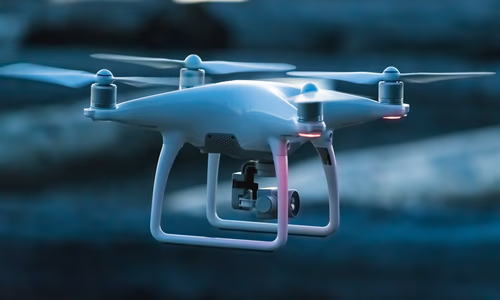
To counter this, the US has rushed 10,000 Merops AI interceptors to the region.
- GPS-Agnostic Navigation: Unlike traditional drones, Merops uses onboard Computer Vision (Optical and IR) to “see” and “track” targets. It doesn’t need a GPS link, making it immune to Iran’s sophisticated electronic jamming.
- Lethal Autonomy: Once a Merops drone is assigned a “Target Profile” (e.g., a Shahed-136), it can autonomously detect, pursue, and kill the target without further human intervention.
Part 4: The Narrative War — AI in Cyber and Info Ops
The conflict is being fought just as fiercely in the Ubiquitous Information Environment.
4.1 Real-Time Threat Detection
Pentagon officials describe using AI to detect cyber-threats in real-time, identifying the unique “Digital Fingerprint” of Iranian state-sponsored hackers before they can breach critical infrastructure.
4.2 Automated Propaganda and Debunking
AI is being used on both sides to:
- Generate Content: Creating realistic-looking video and imagery of battlefield outcomes.
- Automated Fact-Checking: Using AI to rapidly debunk enemy propaganda before it can go viral.
- Sentiment Manipulation: Monitoring global social media to identify and counter narratives that are gaining traction.
Part 5: Vucense Analysis — The Sovereignty and Accountability Gap
At Vucense, we view the US-Iran war as a warning for the future of Digital Sovereignty.
5.1 The Accountability Vacuum
Who is responsible if a Maven-suggested target is a school instead of a munitions depot?
- The software developer?
- The data broker who provided the wrong location data?
- The human operator who only had 3 seconds to review the target? Current international law is not prepared for Algorithmic Accountability.
5.2 The Data Sovereignty Risk
These AI systems are fed by Data Brokers who scrape the location and communication data of millions of civilians. In a war zone, your digital footprint—your phone’s GPS, your social media check-ins—is now a targeting vector. This is the ultimate violation of individual sovereignty.
5.3 The New Arms Race
The US deployment of these systems has already triggered a response from China, Russia, and Iran. Every major power is now racing to build their own “Sovereign War Stack.” If you don’t own the chips, the models, and the data, you are tactically obsolete.
Part 6: Explainer — Sovereignty, Law, and Risk in AI Warfare
To understand the long-term impact of AI on the battlefield, we must look at the Sovereignty, Law, and Risk framework. Here are the core tensions:
- Accountability: Who is responsible if a Maven-suggested target is wrong? Current legal frameworks struggle with the “Automation Bias” of commanders. If an AI identifies a school as a munitions depot and a human approves it in seconds, the responsibility is diluted between the software developer, the data providers, and the operator, creating a dangerous legal vacuum.
- Data Sovereignty: Whose data feeds these systems? These AI “Target Factories” are hungry for data. They ingest everything from satellite imagery to civilians’ private location and communication data scraped from commercial data brokers. This turns the entire digital world into a potential targeting vector, effectively ending the concept of civilian digital sanctuary.
- Arms-Race: The shift to AI War Stacks. US deployments of systems like Maven and Merops are driving China, Iran, and Russia to double down on their own autonomous war stacks. This creates a “Red Queen” effect where nations must continuously automate their defense just to stay at parity, leading to a world of “Abundant Lethal Autonomy” with minimal human oversight.
Part 7: The “Kinetic Inference” Paradox
In 2026, we have reached a state where military superiority is no longer measured by the number of warheads, but by the Quality of Inference. This creates what we call the Kinetic Inference Paradox:
The more a nation relies on AI to make targeting decisions at speed, the less it understands the underlying reasons for those decisions, leading to a state of “Highly Efficient Ignorance.”
7.1 The Black-Box Strike
When a model like Maven identifies a target with 98% confidence, the human operator is presented with a binary choice. However, the 2% uncertainty often contains the “Human Context”—the presence of civilians, the cultural significance of a building, or the potential for diplomatic blowback. In the US-Iran war, the “Black-Box” nature of these models has led to several “Targeting Errors” that CENTCOM has struggled to explain.
7.2 Counter-Inference as a Defense
Iran’s defense strategy has shifted toward Inference Poisoning. By deploying inflatable decoys, electronic spoofers that mimic drone signatures, and even AI-generated “Noise” in communication channels, they aim to “confuse” the Pentagon’s models. This is the new front line: not just shooting down drones, but poisoning the data that directs them.
Part 8: The Global Sovereignty Audit (Military Edition)
How do you measure a nation’s military AI sovereignty? Use the Vucense Military Sovereignty Index (VMSI):
- Model Autonomy: Does the military run its own air-gapped models, or does it rely on cloud-based APIs (like Azure Government or AWS Secret Region)?
- Silicon Security: Does the nation manufacture its own AI chips (e.g., Amazon Trainium) or is it dependent on foreign foundries?
- Data Provenance: Is the training data for military models derived from domestic sources, or is it scraped from global platforms owned by third parties?
- Kinetic Integration: Can the AI models operate in “Offline Mode” during total electronic warfare scenarios?
- Ethical Guardrails: Is there a verifiable, cryptographic audit trail for every AI-suggested lethal strike?
Part 9: Future Outlook — The Proliferation of AI War Stacks
The US-Iran war is the “Spanish Civil War” of AI—a precursor to a much larger global shift.
9.1 The Rise of “Mercenary Models”
We are already seeing the emergence of “Private AI Militaries”—companies that sell not just hardware, but fully integrated “War-as-a-Service” platforms. These platforms include the models, the drones, and the data-broker feeds required to run a “Turnkey War.”
9.2 The “Digital Bill of Rights” for 2026
As these technologies move from the battlefield to domestic borders, there is a growing movement for a Global Digital Bill of Rights. This would mandate that:
- Algorithmic Transparency: Any AI used in a lethal or law-enforcement capacity must be open to public (or independent) audit.
- Data Residency: No citizen’s location data can be used for military targeting without a specific, high-level legal warrant.
- Human-in-the-Loop: A strict, non-negotiable requirement for human intervention in any lethal decision-making process.
Part 10: Action Plan for the Sovereign Citizen in 2026
The technologies being used in the US-Iran war will eventually “trickle down” to domestic policing and surveillance. Here is how to protect your sovereignty:
- Digital Obfuscation: Use tools to minimize your digital footprint. As we discussed in our De-Googling Guide, minimizing data extraction is now a survival skill.
- Audit Your Tech: Be aware of how your data might be sold to data brokers. Use privacy-first search engines and encrypted communication.
- Support Sovereign Infrastructure: The only way to counter centralized “War Stacks” is to support decentralized, local-first AI and open-source hardware.
Conclusion: Reclaiming Sovereignty in the Age of AI War
The US–Iran conflict has shown us that the “Frontier of Intelligence” is also the “Frontier of Violence.” When we allow algorithms to decide who lives and who dies, we surrender the most fundamental aspect of human sovereignty: Moral Agency.
At Vucense, our mission is to provide the tools and knowledge to resist this centralization of power. Whether it is through Self-Hosting your own models or advocating for Sovereign Silicon, the goal remains the same: Digital Independence.
The war in 2026 is a mirror. It shows us a future where intelligence is abundant, but humanity is optional. It is up to us to ensure that the “Sovereign AI” of the future is used to protect life, not just optimize its destruction.
Related Articles
- OpenAI’s Aggressive Expansion 2026: The Future of Sovereign AI Infrastructure
- Amazon Trainium: The Silicon powering the 2026 AI War Stacks
- The Governance Crisis: Why US AI Policy is a Democracy Crisis in 2026
- The 2026 Infrastructure Audit: Who owns the silicon?
- Robot Dogs and Data Centers: The new security ROI
Author’s Note: This report was compiled by Divya Prakash and the Vucense Editorial Board using verified military briefs and geopolitical risk assessments from March 2026.