Quick Answer: In a landmark legal battle for corporate ethics and digital sovereignty, Anthropic is suing the Trump administration over a “supply chain risk” designation. The label was applied after Anthropic refused to allow its Claude AI model to be used in autonomous weapons and mass surveillance. Now, nearly 150 retired federal and state judges have joined the fight, filing an amicus brief in support of the AI company.
The Cost of Ethical Redlines: Anthropic’s Stand
For years, Anthropic has positioned itself as the “safety-first” AI company. In March 2026, that commitment was put to the ultimate test. During negotiations with the Pentagon over the use of Claude in classified systems, the company refused to cross two key ethical boundaries:
- No Autonomous Weapons: Anthropic would not allow its models to be integrated into systems that can autonomously select and engage targets.
- No Mass Surveillance: The company refused to permit the use of Claude for the wide-scale monitoring of American citizens.
In response, the Defense Department designated Anthropic a “supply chain risk,” a label typically reserved for foreign-owned companies associated with adversaries like China or Russia.
Part 1: The Judicial Support
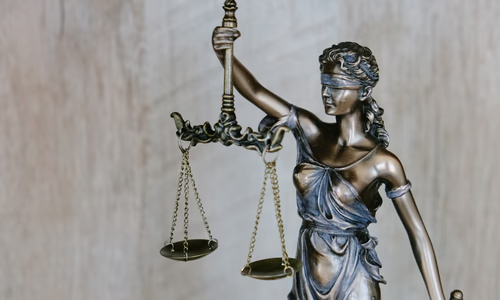
The legal community has reacted with alarm to the Pentagon’s move. An amicus brief filed on Tuesday by nearly 150 retired judges—appointed by both Republican and Democratic presidents—argues that the government overstepped its bounds.
The judges wrote that the Pentagon “misinterpreted the statute and violated the necessary procedures” when it applied the label. They emphasized that Anthropic is not trying to force the government to use its products, but rather asking that it not be “punished on its way out the door” for adhering to its own ethical guidelines.
Part 2: The Economic and Political Fallout
The “supply chain risk” designation is more than just a label—it is a financial death sentence for many tech companies.
- Financial Impact: Anthropic’s CFO has stated in legal filings that the company is at risk of losing “hundreds of millions” in revenue in 2026 as private firms with military contracts are forced to separate their work from Anthropic’s tools.
- White House Response: Spokesperson Liz Huston has been blunt, stating that the President “will never allow a radical left, woke company” to dictate how the military operates.
Part 3: The Sovereignty Question
At Vucense, we see this as a watershed moment for Digital Sovereignty. If a private company can be designated a “security risk” simply for maintaining ethical standards that protect citizen privacy, the very concept of a free and independent tech ecosystem is under threat.
Why This Matters to You:
- Corporate Ethics: Can a business hold onto its ethical guidelines when contracting with the government? Or must all tech companies eventually yield to the state’s demands?
- User Privacy: Anthropic’s refusal to participate in mass surveillance is a direct win for individual privacy. The government’s retaliation is a direct threat to that privacy.
- The Precedent: This case sets the stage for how all future AI companies—from giants like Microsoft to local-first startups—will interact with national security agencies.
What’s Next?
A hearing on Anthropic’s request for a preliminary injunction is set for next Tuesday. The outcome of this case will likely define the relationship between Silicon Valley and the Pentagon for the rest of the decade.
Vucense Take: This standoff highlights why Local-First, Sovereign AI is so critical. When you run your own models on your own hardware, you don’t have to worry about a government “supply chain risk” label or ethical compromises. You are the architect of your own digital future.
Stay sovereign. Stay ethical.