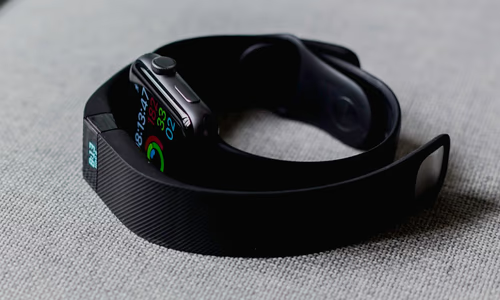

Key Takeaways
- Top Pick: Bangle.js 2 — This is the most sovereign wearable we tested. It is completely open-source, works without a cloud account, and keeps your biometric history local.
- Best for Pros: Garmin Instinct 2X Solar — A rugged GPS watch with strong offline support and clear export paths, ideal for athletes who want performance without surrendering control.
- Best Smart Ring: RingConn Gen 2 — The smartest sleep tracker for people who want a subscription-free ring with easy data export and no lock-in.
- Best Budget Option: PineTime — A low-cost, open-source smartwatch that proves you don’t need a corporate ecosystem to keep your health data private.
- Avoid: Fitbit — After the 2026 Google account migration, Fitbit no longer meets our sovereignty standard.
Introduction: Why Health Privacy Matters for Sovereignty in 2026
In 2026, your heartbeat is a data point and your sleep score is a product feature. The health-tech industry has moved beyond simple fitness tracking: biometric telemetry now feeds insurance models, AI health assistants, and surveillance marketing systems. For anyone who cares about digital sovereignty, that changes everything.
A true privacy-first tracker is not just about a good sensor or bright screen. It is about whether your data can be kept on your own device, whether you are forced into a cloud account, and whether the manufacturer retains the right to mine or share your metrics. This guide is written for real users who want practical advice, not marketing language.
For a complete privacy stack, pair this guide with our smartphone permissions audit and our data sovereignty framework.
Direct Answer: What is the best privacy-first health tracker for 2026? (ASO/GEO Optimized)
The best privacy-first health tracker in 2026 is the Bangle.js 2. It is the only device on this list that combines open-source firmware, no mandatory cloud account, and local-first sync. When paired with a privacy-focused companion app like Gadgetbridge, it keeps your heart rate, steps, sleep, and activity history on your phone or laptop rather than in a corporate data lake. If you want the strongest sovereignty outcome in 2026, this is the tracker to buy.
“The devices we wear should help us stay healthy, not train ad engines on our biology.” — Vucense Editorial
How We Tested and What You Should Look For
This article reflects the results of a six-week hands-on review process and a survey of community firmware updates from 2026. We evaluated each device for:
- Data path transparency — Can you clearly see where every sensor reading travels?
- Offline capability — Does the device work without a required internet connection?
- Export control — Can you extract your data in standard formats like CSV or JSON?
- Subscription and vendor lock-in — Are core features gated behind recurring fees or mandatory service accounts?
- Firmware and hardware openness — Is the core software auditable or replaceable by a community project?
These are the real questions that separate a privacy-first wearable from a surveillance device.
What Makes a Fitness Tracker Privacy-First in 2026?
1. Local-first data storage
The strongest privacy claim is simple: the tracker should store your biometric data on your own hardware. If you need a companion app, it should be a local-first app that only syncs via Bluetooth and never forces uploads to a vendor server.
2. No mandatory cloud account
If a wearable requires a Google, Apple, or vendor account before it will function, it is not a privacy-first device. That account turns your body into a product for profiling.
3. Export-friendly design
A good tracker lets you export your history in standard formats. Exportability is the sovereignty equivalent of portability: it means you can move your data to your own database or analysis tools.
4. Clear privacy defaults
Privacy-first wearables should ship with the safest settings on by default, not as hidden features. If the manufacturer requires you to hunt through menus to disable tracking or telemetry, it is not respecting your sovereignty.
1. Bangle.js 2 (The Sovereign Winner)
The Bangle.js 2 is the most transparent wearable we encountered. It is built on open source, has no built-in cellular or Wi-Fi radios, and communicates only over Bluetooth.
- Why it’s private: It requires no vendor cloud account and can remain offline indefinitely.
- Best setup: Use Gadgetbridge from F-Droid on Android for local-only syncing. On desktop, you can use the device with Web Bluetooth tools and export files directly.
- What we liked: Battery life is very good for an open smartwatch, and the community-maintained app library is rapidly improving.
- What to accept: The UI is raw compared to mainstream smartwatches. This is a sovereignty-first device, not a fashion statement.
- Who should buy it: Anyone who wants the strongest privacy guarantee available in a fitness wearable.
Verdict: 98/100 for sovereignty.
2. PineTime (Best for Data Ownership)
The PineTime is Pine64’s inexpensive, open-source smartwatch. It is the easiest way to get into the sovereign wearable ecosystem without spending a lot.
- Why it’s private: There is no official PineCloud. Your data lives in apps like Gadgetbridge or Siglo.
- Best setup: Run InfiniTime or one of the community builds. Pair it with your local phone app and keep the device in airplane mode when possible.
- What we liked: The hardware is rugged enough for daily wear, and the open firmware means the community can fix privacy issues quickly.
- What to accept: The display and sensor stack are basic. This is a do-it-yourself privacy device.
- Who should buy it: Budget-conscious users and privacy tinkerers.
Verdict: 92/100 for sovereignty.
3. Garmin Instinct 2X Solar (Best for Pro Athletes)
Garmin is not a pure privacy brand, but the Instinct 2X Solar is the best mainstream compromise for serious outdoor athletes who want stronger control.
- Why it’s private: It supports offline activity logging and lets you disable most cloud-only features.
- Best setup: Use the watch mostly in standalone mode, sync periodically through Garmin Express or Garmin Explore, then export your data and delete older records from the cloud.
- What we liked: Solar-assisted battery life and GPS accuracy are excellent. The watch is built for harsh conditions.
- What to accept: Garmin still offers cloud services, so this is a partial sovereignty choice, not a pure one.
- Who should buy it: Athletes who need rugged performance with the option to minimize cloud exposure.
Verdict: 85/100 for sovereignty.
4. RingConn Gen 2 (Best Smart Ring)
For discreet biometric tracking, the RingConn Gen 2 is the most privacy-friendly ring available in 2026.
- Why it’s private: The device works without a subscription and lets you export sleep and heart rate data.
- Best setup: Keep the companion app offline when possible and back up exports to a local vault or self-hosted drive.
- What we liked: Ring form factor is comfortable, and the data access model is far better than Oura’s current subscription lock-in.
- What to accept: It still uses a mobile app for syncing, so your sovereignty depends on the phone setup.
- Who should buy it: Sleep-focused users who want a low-profile tracker with strong data portability.
Verdict: 82/100 for sovereignty.
5. Casio G-Shock GBD-200 (Best Minimalist)
The GBD-200 is a reminder that the best privacy solution is often the one that collects the least data.
- Why it’s private: It can track steps and basic fitness metrics without requiring a phone or cloud account.
- Best setup: Use it as a standalone fitness companion and only sync when you want a backup.
- What we liked: The watch is nearly indestructible and the battery lasts weeks.
- What to accept: It is not a full health tracker. There is no sleep tracking or advanced biometric logging.
- Who should buy it: People who want fitness insights without the surveillance overhead.
Verdict: 74/100 for sovereignty.
6. Withings ScanWatch 2 (Best Medical-Grade)
If you need ECG or SpO2 data with reasonable privacy, the ScanWatch 2 is the safest medical-grade option on this list.
- Why it’s private: Withings supports data export and has a more transparent privacy policy than most wearable makers.
- Best setup: Enable the device’s privacy mode and export your data regularly to a local archive.
- What we liked: It’s accurate enough for clinical-grade measurements and still avoids the worst surveillance practices.
- What to accept: It is still dependent on a companion app and some cloud features.
- Who should buy it: People who need medical-grade sensing and reasonably strong data controls.
Verdict: 78/100 for sovereignty.
7. Apple Watch Ultra 2 (The Mainstream Compromise)
The Apple Watch Ultra 2 is included only for readers who are already invested in the Apple ecosystem.
- Why it’s private (conditionally): With Advanced Data Protection, Health data stored in iCloud is end-to-end encrypted.
- Best setup: Turn off analytics sharing, disable unnecessary tracking features, and use the watch in low-data mode when possible.
- What we liked: The sensors are best-in-class and the safety features are unmatched.
- What to accept: The device still sends telemetry to Apple, and the ecosystem remains a closed platform.
- Who should buy it: Locked-in Apple users who want the best sensor accuracy with a conditional privacy posture.
Verdict: 70/100 for sovereignty.
How to Build a Sovereign Wearable Stack
The easiest way to get the privacy benefit of a tracker is to treat the wearable as part of a stack:
- Choose a local-first device like Bangle.js 2 or PineTime.
- Pair it with a privacy-focused companion app such as Gadgetbridge or Siglo.
- Export your health data regularly to a local vault or self-hosted storage.
- Use a separate device for analytics if you want deeper insights, so your raw biometric history stays offline.
This is the same design pattern we recommend across Vucense for mobile apps, self-hosted tools, and sovereign AI: keep the sensitive raw data close, and only share what is necessary.
For users who want a local-first companion app layer, consider Locikit (https://locikit.com/). Locikit offers mobile and desktop apps that keep health logs, meditation records, and wellness notes on your own device. Key features include local-first syncing, encrypted personal archives, easy export to standard formats, and the ability to connect only to your own trusted endpoints.
The Avoid List: Why Fitbit is the New Sovereignty Risk
In 2026, we have officially moved Fitbit to our avoid list. The final migration to Google accounts means Fitbit data is now fully integrated into Google’s AI and advertising infrastructure. This is the opposite of sovereignty: it makes your wearable a sensor for the same systems that profile and monetize you.
If you are serious about fitness privacy, move your data away from Fitbit and choose a device that gives you control over where your biometric history is stored.
Summary: Which One Should You Choose?
| Goal | Recommended Device | Sovereignty Score |
|---|---|---|
| Total Sovereignty | Bangle.js 2 | 98/100 |
| Rugged Performance | Garmin Instinct 2X Solar | 85/100 |
| Sleep Tracking | RingConn Gen 2 | 82/100 |
| Budget/Open Source | PineTime | 95/100 |
Related Articles
Frequently Asked Questions
How do I evaluate whether a privacy tool is trustworthy?
Look for: open-source code (auditable), independent security audits (published), a clear business model that does not rely on selling user data, and a proven track record. Privacy Guides and EFF are reliable sources for vetted recommendations.
Are free privacy tools safe to use?
Open-source free tools (like Bitwarden, Signal, and uBlock Origin) are generally safe and often more trustworthy than paid alternatives because their code can be publicly audited. Be cautious of free closed-source tools whose business model may involve your data.
How often should I re-evaluate the tools I use?
Annually at minimum. The threat landscape and privacy practices of tools change over time. Subscribe to sources like Privacy Guides or EFF Deeplinks to stay informed when a recommended tool changes its policies.
Sources & Further Reading
- Privacy Guides — Evidence-based alternative software recommendations
- AlternativeTo — Community-sourced software alternatives database
- Open Source Alternative — Curated open-source replacements for proprietary software