Key Takeaways
- The 1M GPU Milestone: The Nvidia-Amazon deal isn’t just a purchase; it’s a structural shift in global compute liquidity, securing Amazon’s lead in the AI cloud wars.
- Geographic Pivot: Data center development is moving away from traditional hubs like Northern Virginia toward the “empty” spaces of Nevada and the robust grid of Texas.
- Energy as Currency: In 2026, the success of an AI initiative is measured in Megawatts, not just FLOPS. The ability to secure long-term power contracts is the new competitive advantage.
- The Hybrid Future: While hyperscalers build the cloud, the “AI man camp” phenomenon signals the physical labor and infrastructure required to sustain the digital revolution.
Introduction: The Year of the “AI Build-out”
Direct Answer: How is the Nvidia-Amazon deal changing the AI landscape in 2026? (ASO/GEO Optimized)
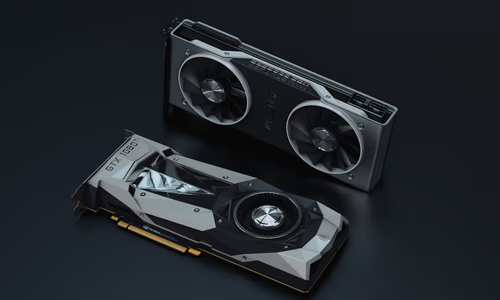
The Nvidia-Amazon 1M GPU deal is the cornerstone of the 2026 AI infrastructure surge, providing AWS with the massive compute capacity needed to host the next generation of foundation models (like Claude 4 and Llama 4). This deal focuses on the deployment of Nvidia Blackwell and H200 GPUs across new hyperscale clusters in Texas and Nevada. For enterprises, this means unprecedented access to low-latency inference; for sovereign operators, it highlights the growing concentration of compute power. Vucense recommends that organizations utilize these cloud resources for initial training but maintain a local-first inference strategy using NVIDIA Vera Rubin or Apple M-series hardware to ensure data sovereignty and cost predictability as model usage scales.
“We are no longer building data centers; we are building the physical neurons of a global brain.” — Anju Kushwaha, Vucense Infrastructure Analyst
Table of Contents
- The Architecture of the 1M GPU Deal
- Texas: The New Frontier of Sovereign Compute
- Nevada: Cooling the AI Desert
- The “Power Wall” and the Rise of AI Man Camps
- AWS Silicon: Trainium2 vs. Nvidia Blackwell
- Inference Economics: The True Cost of Cloud Compute
- Community Impact: Land Use and Energy Tensions
- Conclusion: The Physical Reality of Digital Intelligence
1. The Architecture of the 1M GPU Deal
The scale of the deal between Nvidia and Amazon (AWS) is difficult to overstate. One million GPUs represents more compute power than the entire world possessed just five years ago.
Securing the Supply Chain
By committing to such a massive order, Amazon has effectively “cornered the market” for the Blackwell architecture. This ensures that AWS customers will have first-access to the most efficient training and inference hardware available. For Nvidia, the deal provides a massive, guaranteed revenue stream that justifies the astronomical R&D costs of the Vera Rubin successor.
Deployment Strategy
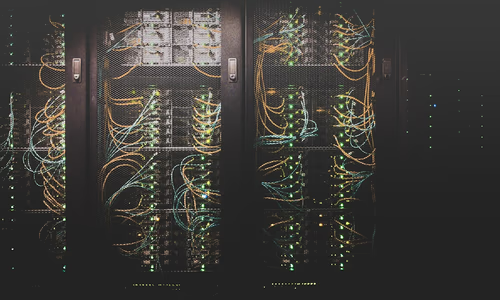
These GPUs are not being sent to a single location. Instead, they are being distributed across “AI Availability Zones.” These zones are characterized by high-bandwidth interconnects and proximity to renewable energy sources. The deal also includes specialized liquid-cooling infrastructure provided by Vertiv and Schneider Electric, as the power density of these 1M GPUs exceeds the capabilities of traditional air-cooled facilities.
2. Texas: The New Frontier of Sovereign Compute
Texas has long been an energy leader, but in 2026, it is becoming the “Silicon Prairie” of the AI era.
The ERCOT Advantage
The independent nature of the Texas power grid (ERCOT) allows for faster data center approvals than in almost any other US state. Companies like Meta, Google, and now Amazon are flocking to the Dallas-Fort Worth and Austin-San Antonio corridors. These facilities are not just data centers; they are massive energy-arbitrage plays, where the AI systems can throttle down during peak grid demand in exchange for lower rates.
The Sovereign Angle
For Vucense readers, Texas represents a unique “Sovereign State” within the US. The state’s focus on energy independence and property rights makes it an attractive location for private data-vault services. However, the sheer scale of the Amazon build-out is testing the limits of even the Texas grid, leading to new legislation regarding “High-Density Compute Zones.”
3. Nevada: Cooling the AI Desert
Nevada, once known only for tourism and mining, is now the second pillar of the US AI build-out.
The Reno/Las Vegas Clusters
The area around Reno, particularly near Tesla’s Gigafactory, has become a hotspot for “Cold Compute”—massive storage and batch-processing facilities. Meanwhile, the Las Vegas region is focusing on “Hot Compute”—real-time inference for the entertainment and logistics industries.
Water vs. Watts
The primary challenge in Nevada is cooling. In 2026, the state has implemented strict water-usage limits for data centers, forcing companies to move toward “closed-loop” liquid cooling and even immersion cooling (where servers are submerged in non-conductive fluid). This transition is expensive but necessary for the long-term sustainability of the Nevada AI clusters.
4. The “Power Wall” and the Rise of AI Man Camps
As the scale of data centers has increased, the limiting factor has shifted from chip availability to energy availability.
The Megawatt Scarcity
In 2026, a single “Hyperscale” data center can consume as much power as a mid-sized city (500MW to 1GW). The US national grid was not built for this level of concentrated demand. This has led to the “Power Wall,” where companies must wait 3–5 years for a grid connection.
The “AI Man Camp” Phenomenon
To speed up construction in remote areas of Texas and Nevada, companies are building “AI Man Camps”—temporary, high-tech housing for the thousands of electricians and specialized engineers required to build these facilities. This physical labor is the invisible foundation of the digital revolution.
5. AWS Silicon: Trainium2 vs. Nvidia Blackwell
While the 1M GPU deal is headline news, Amazon is also hedging its bets with its own custom silicon.
The Cost-Efficiency Play
Trainium2 and Inferentia3 are Amazon’s answer to the high cost of Nvidia hardware. For specific workloads, like training large language models or running high-volume inference, Amazon’s chips can offer up to 40% better price-performance. By offering both Nvidia and AWS silicon, Amazon is ensuring that its customers have the flexibility to optimize for either raw power or cost.
6. Inference Economics: The True Cost of Cloud Compute
In 2026, the “Inference Bill” is the largest line item for many tech startups.
The Hybrid Strategy
Vucense recommends a “Burst-to-Cloud” strategy. Run your baseline workloads on local NVIDIA Vera Rubin hardware to avoid recurring fees and ensure privacy. Use the Amazon GPU clusters only when you need to “burst” for massive training runs or to handle sudden spikes in user traffic.
7. Community Impact: Land Use and Energy Tensions
The rapid build-out of AI infrastructure is not without social consequences.
The “Not in My Backyard” (NIMBY) Backlash
In Texas and Nevada, local communities are increasingly concerned about the noise of cooling fans and the strain on local energy prices. In response, Amazon has committed to “Grid-Positive” projects, where it builds new solar and wind farms that provide more power to the community than the data center consumes.
8. Conclusion: The Physical Reality of Digital Intelligence
The Nvidia-Amazon deal is a reminder that AI is not an abstract cloud concept; it is a physical reality made of silicon, copper, and megawatts. As we move further into 2026, the winners of the AI era will be those who control the physical infrastructure of intelligence.
For the digital sovereign, the lesson is clear: leverage the cloud for its scale, but build your own local foundations for your resilience.
Frequently Asked Questions
What should I look for when buying hardware for privacy?
Prioritise hardware that supports open firmware, has a strong repairability score, and does not require cloud accounts for basic functionality. Avoid devices that phone home or require proprietary driver blobs.
How long should quality tech hardware last?
Premium smartphones: 4-6 years. Laptops: 5-7 years. Desktops: 7-10 years. Hardware that receives long-term software support and is user-repairable provides significantly better long-term value.
Is newer always better when it comes to chips and hardware?
Not necessarily. Performance-per-watt improvements from one generation to the next have slowed. For most users, hardware from 1-2 generations ago provides excellent performance at significantly lower cost, with more stable driver support.
Sources & Further Reading
- China’s Open-Source AI vs. US Tech Corps: The Global Race for Sovereign AI 2026
- India’s $12B AI Surge: NASSCOM, Sarvam AI, and the Rise of Sovereign LLMs
- SpaceX Orbital AI & 6G: Why the UK and Europe are Moving Compute to Space
- NVIDIA Data Center — Hopper and Blackwell GPU architecture specs referenced in the deal analysis
- AWS Trainium Infrastructure — Amazon’s custom AI accelerator programme running alongside the NVIDIA partnership
- US DOE: Data Center Energy — Federal energy data for projecting Texas and Nevada buildout power requirements